
Trading Exchange
Buy low, sell high, read the market
Everyone is dealt cards and trades based on the total value of all cards in play.
Players: 2+ (recommended 2–8). Maximum depends on cards dealt (52 ÷ cards per player).
Tutorial
Conceptualising Trading
Assume that you and every other player each start with a pot of gold. Every nugget of gold is identical to all others and they have equal value.
Think of each trade as though you're signing a contract to buy or sell a nugget of gold at a fixed price at the end of the game.
The true value of a nugget of gold is the sum of all cards in play. During the game, you don't know this exact value until everyone's cards have been revealed, so you must estimate using the information that is available to you.
If you make an agreement to buy a nugget at a certain price and the final value is higher than that price, you profit because you buy it for less than you can sell it for. If lower, you lose money.
If you make an agreement to sell a nugget at a certain price and the final value is lower than that price, you profit because you sell it for more than you can buy it back for. If higher, you lose money.
Understanding Orders
Players must always submit a bid and offer pair of orders:
- The bid order is the highest price that you would be willing to buy a gold nugget for.
- The offer order is the lowest price you would be willing to sell one of your gold nuggets for.
The price of these orders should reflect your estimate. Your estimate should depend on the value of the cards you can see and your best guess of the value of the rest of the cards.
The difference between your bid and offer should reflect the confidence you have in your estimate but also incorporate your risk appetite and willingness to trade.
If your bid is very low and your offer is very high, you will never trade. You can't lose if you don't trade, but you also can't win. Besides, the game isn't fun if you don't trade.
How does a trade occur?
A trade will occur instantaneously whenever one player's bid order is higher than or equal to another player's offer order.
Conceptually, if Player A is willing to buy a gold nugget for $15 and Player B is willing to sell their gold nugget for $13, then they can make a deal. In this example, the game will automatically match them at the mid point of $14
Auction
To start the game, players are given unlimited time to submit their auction orders.
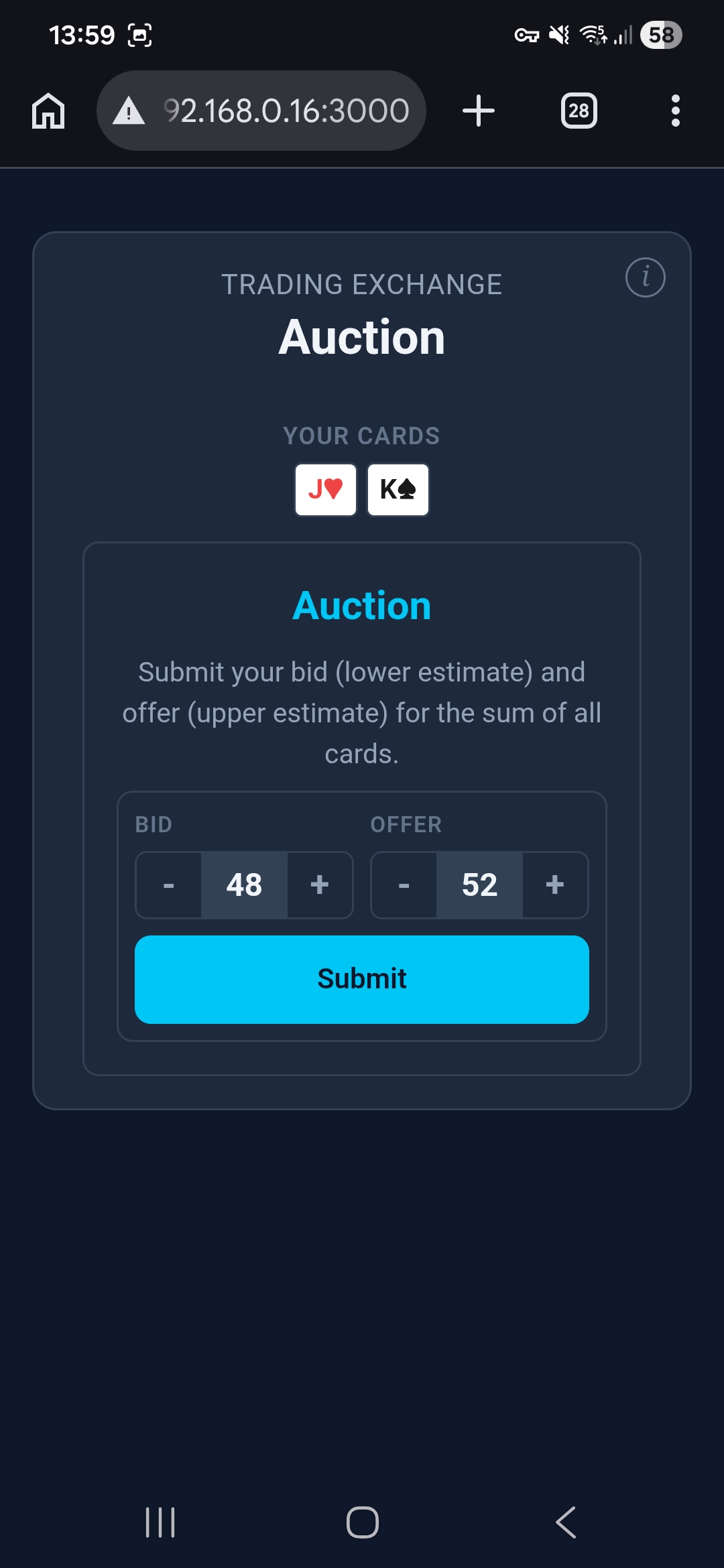
We are willing to buy for 48 and sell for 52.
Round 1 — Initial Trading
During Round 1, you cannot see other players' cards but you can see any trades that have happened and what price each player has their orders.
Players can update their orders as many times as they like.
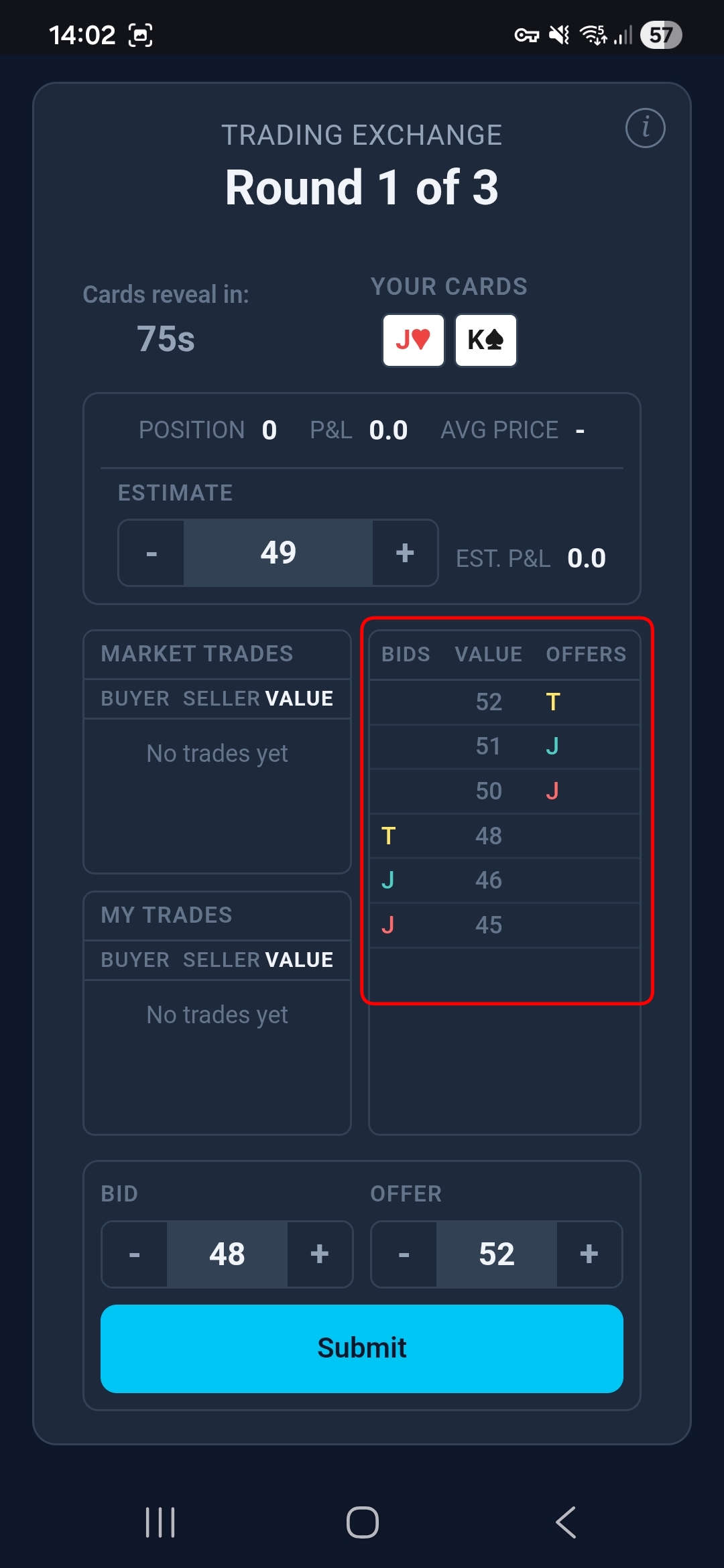
No trades occur from the initial auction orders because no player's bid is higher than any other player's offer.
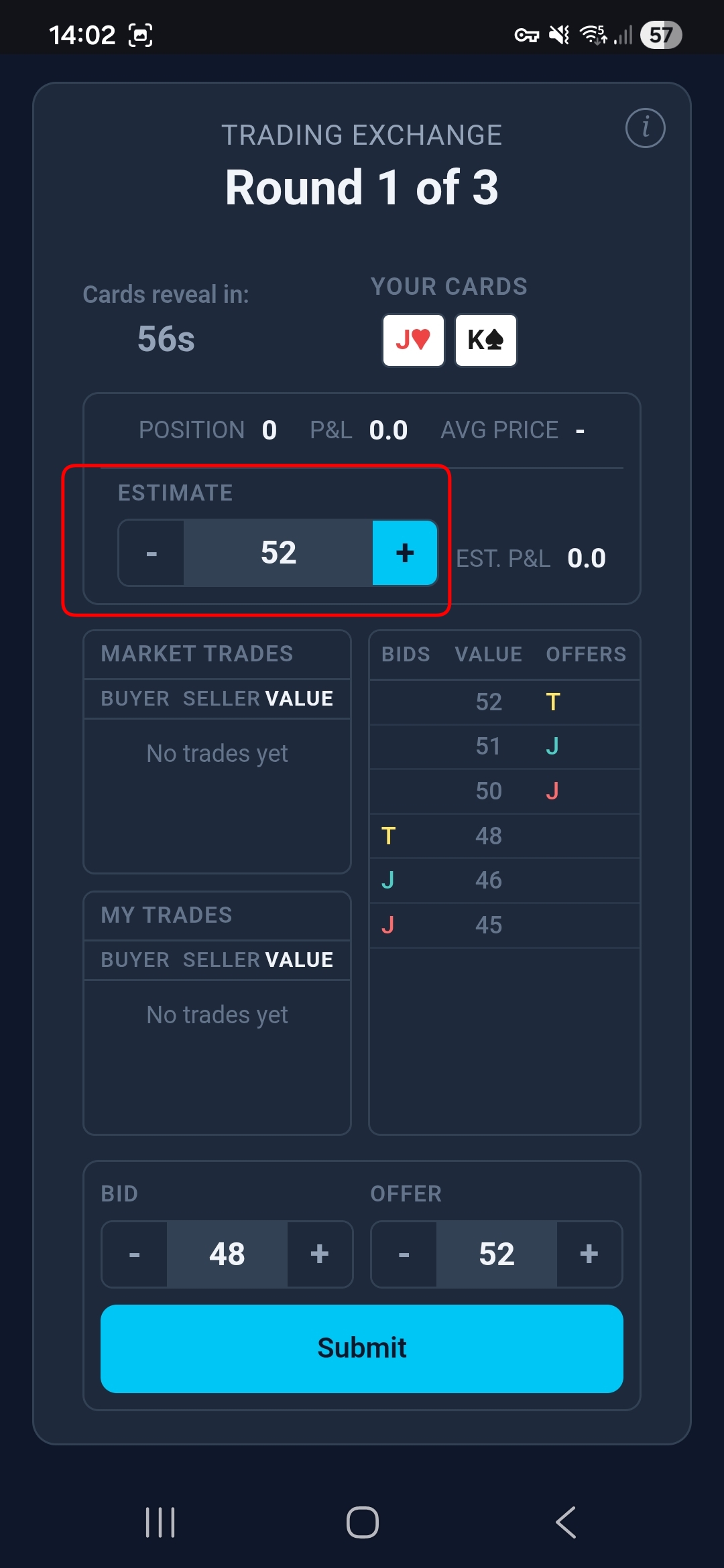
The estimate defaults to the mid point of the highest bid in the market and the lowest offer. Adjusting this to your estimate helps to keep track as new information is revealed later.
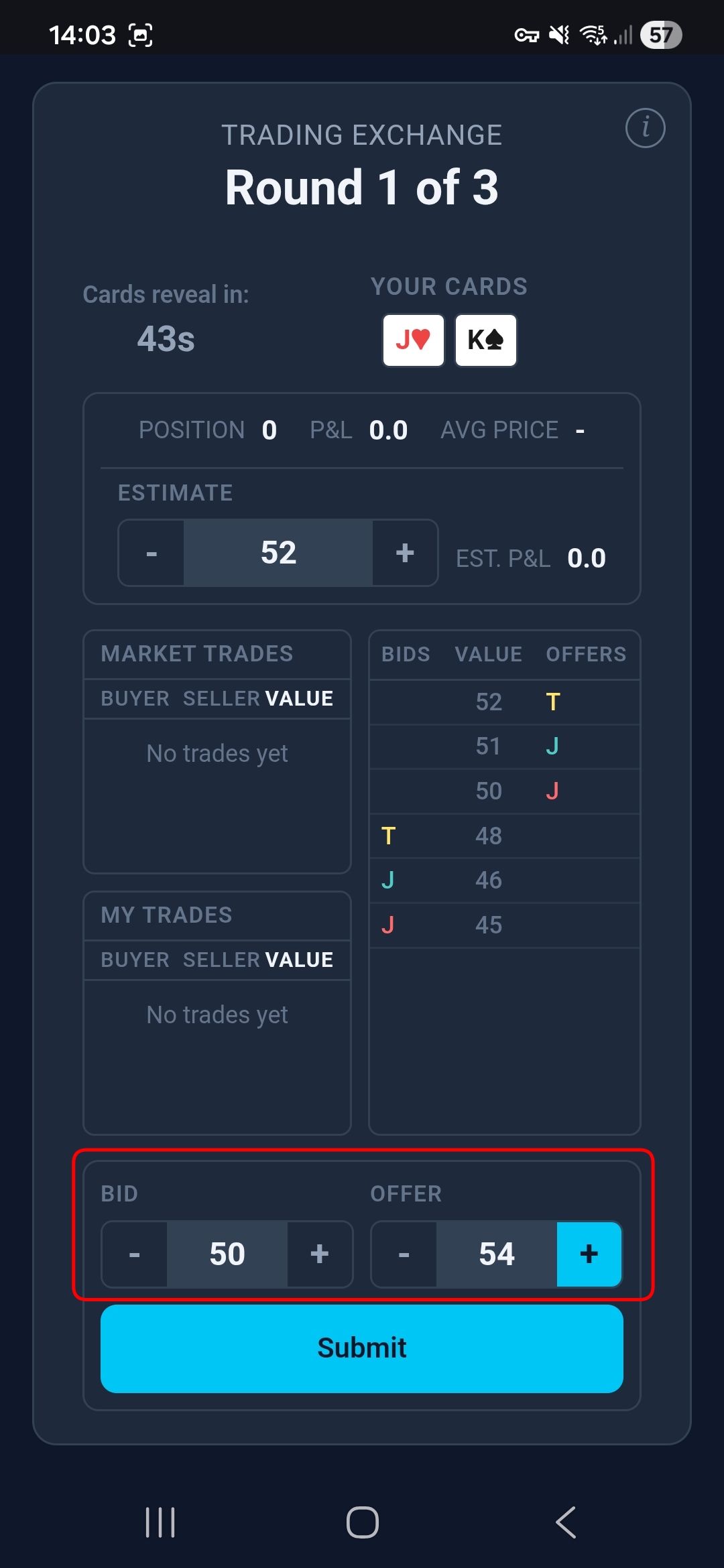
We adjust our orders up to 50 and 54.
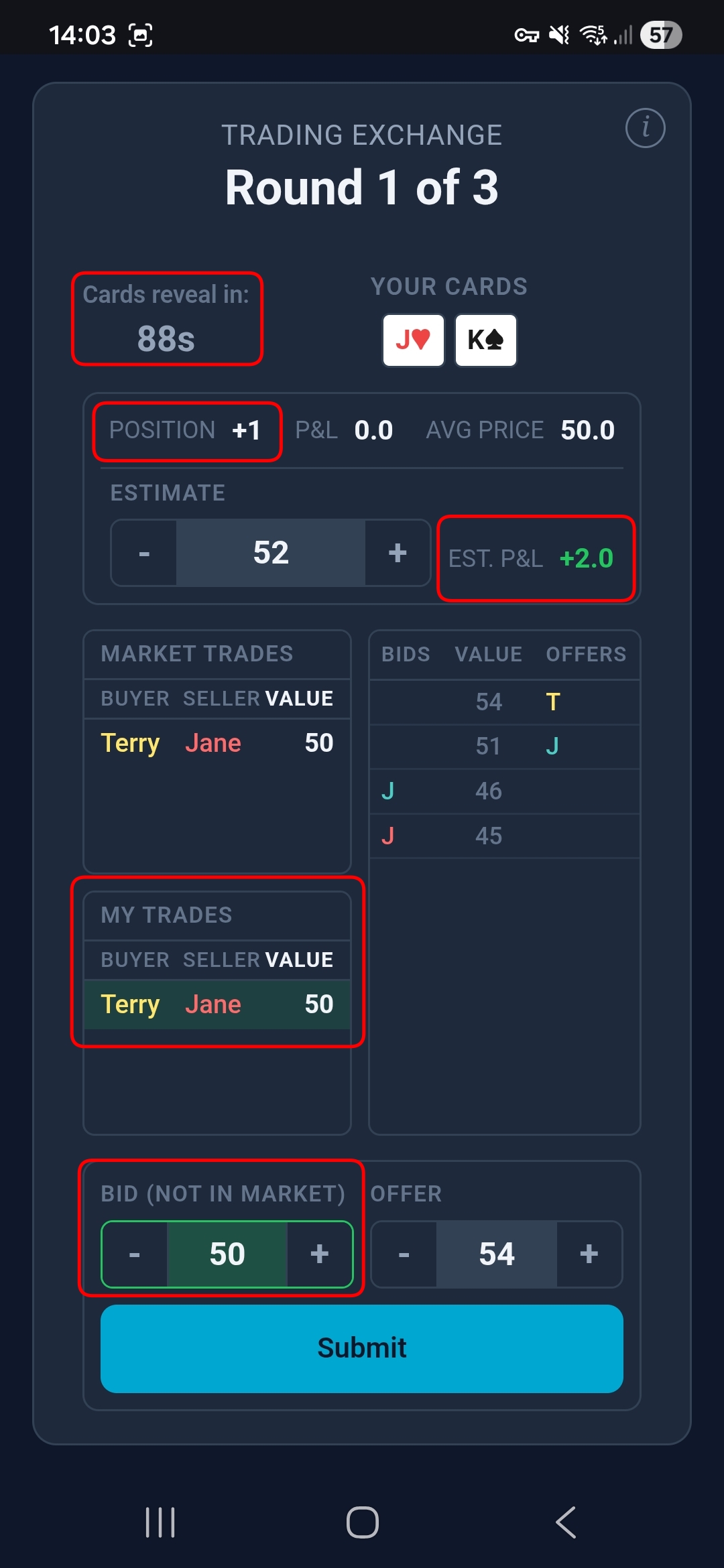
Upon submission, our 50 bid immediately trades with Jane's 50 offer and our position goes to +1. In other words, we have bought 1 gold nugget for $50 from Jane.
Based on our current estimated price, our profit is going to be $2.
Now that our bid has traded, it is no longer in the market, and Jane also does not have an offer in the market.
After every trade, the cards reveal timer is reset.
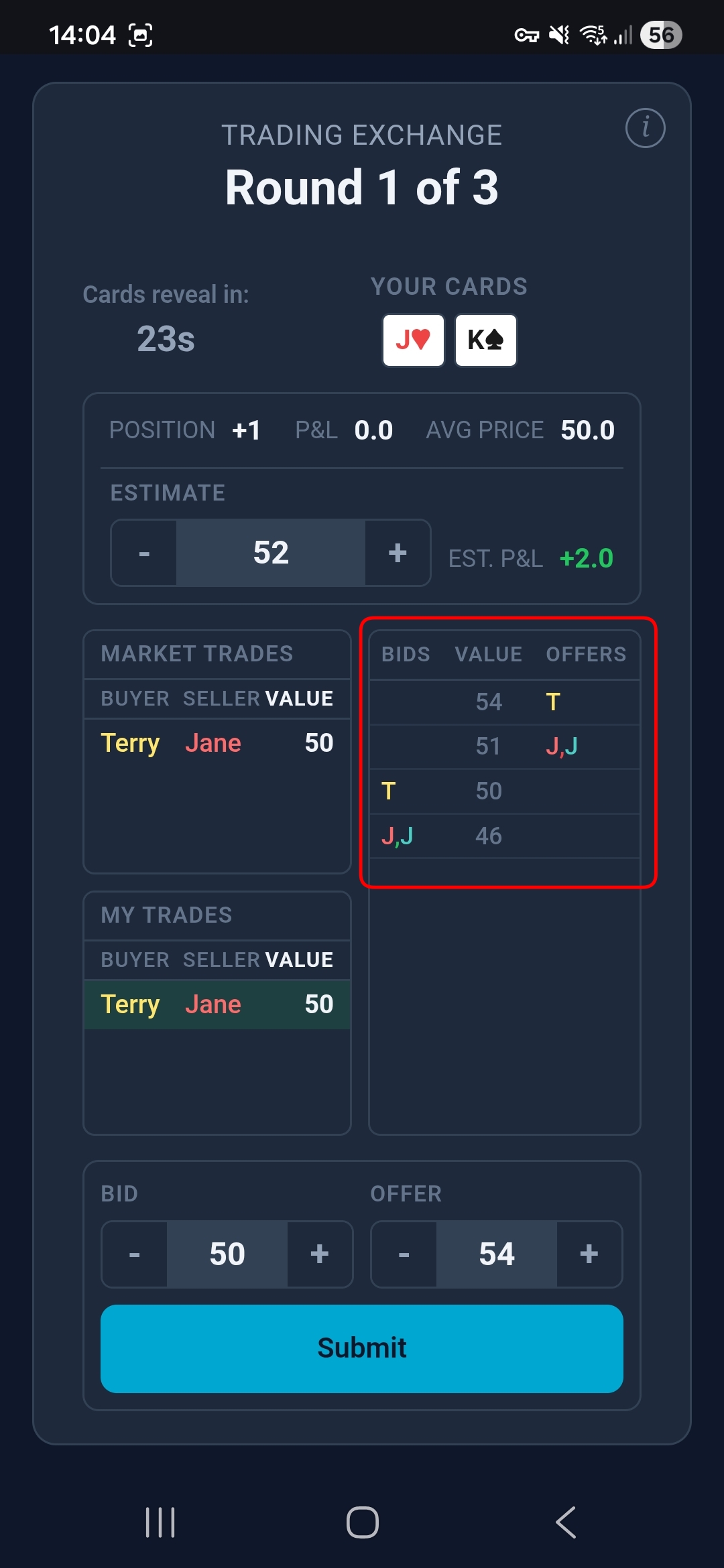
Trades can give insight into the value of other players' cards. For example, our estimate is above 50, but Jane's estimate is probably below that. Since we were the aggressor in this trade, it is probably a strong signal to Jane that her estimate might too low.
The cards reveal timer resetting allows time to react to any trades. In this instance, Jane "retreats" and increases her offer while we reassert our willingness to buy at 50.
In a more advanced version of the game, the admin can set an auto-submit timer. This puts pressure on players to adjust their order prices quickly upon trading before the game just submits whatever values are in their bid and offer inputs. Players who are not quick enough may find themselves accumulating big positions at adverse prices. The game is most fun when players are actively in the market, so even if this setting is not turned on, try to get your orders back in the market soon after trading.
Round 2 — First Cards Reveal
In the second round, one card from each player is revealed. The second round of trading begins when the first round timer expires. React quickly to take advantage of the new information.
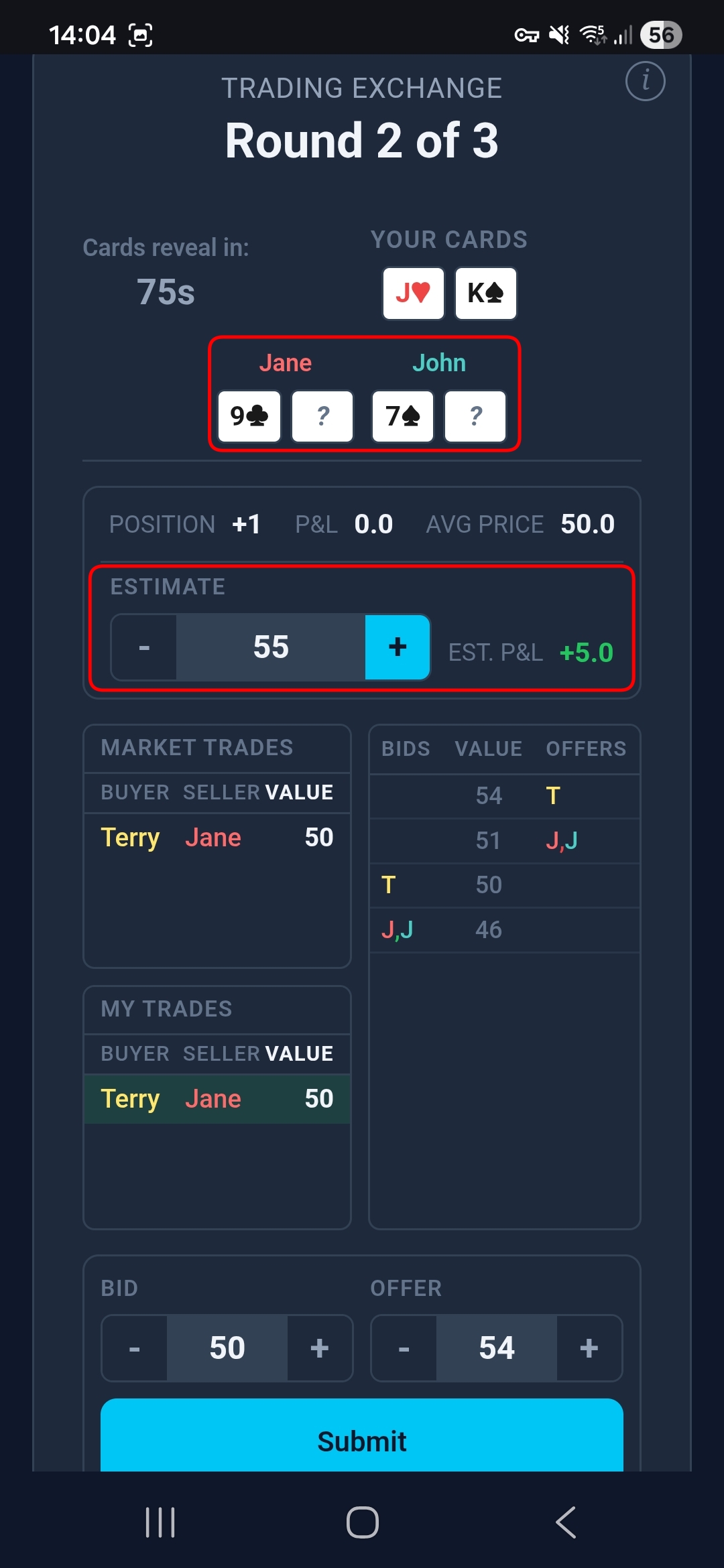
We adjust our estimate up in reaction to the new information. This is good news because we bought low at $50.
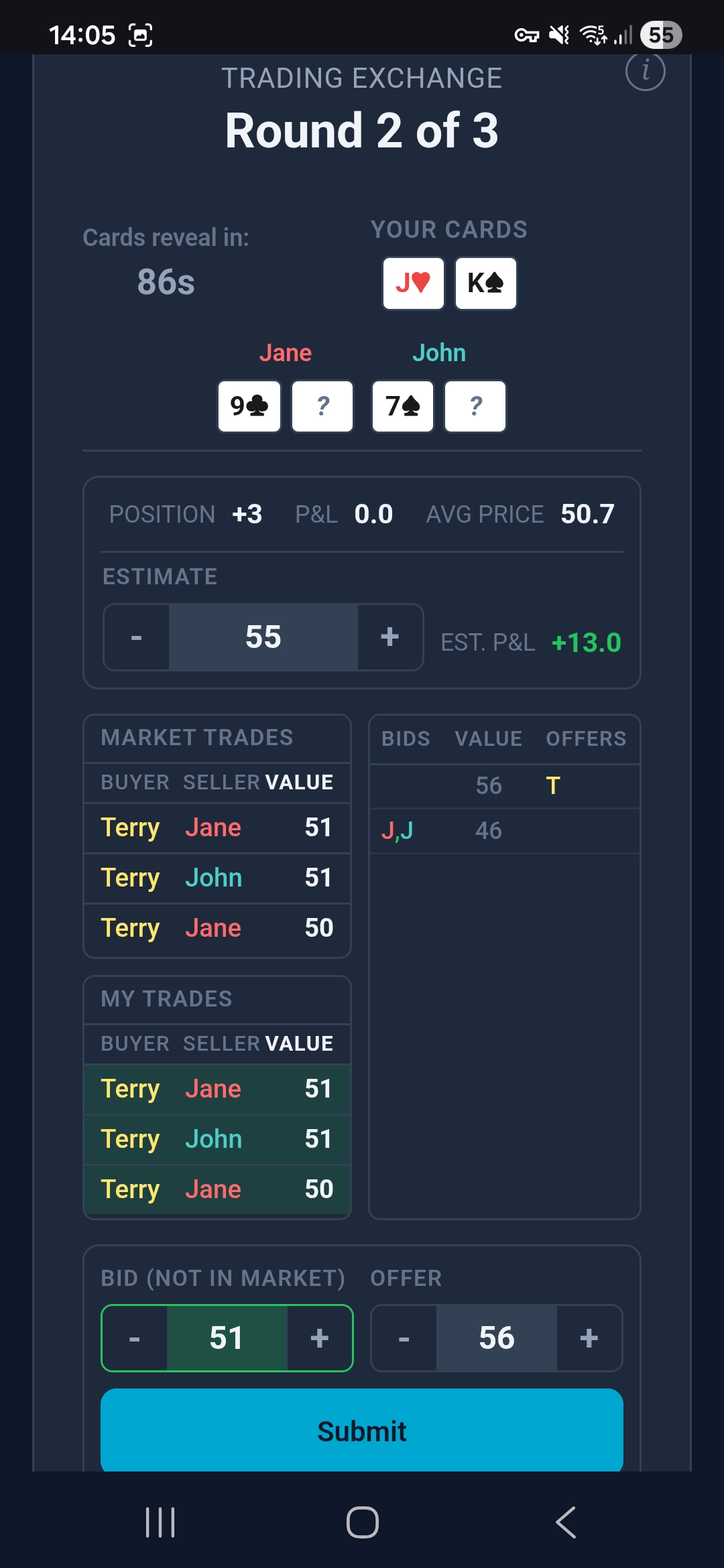
We're the first to update our orders and we submit and resubmit to buy both Jane's and John's $51 offers.
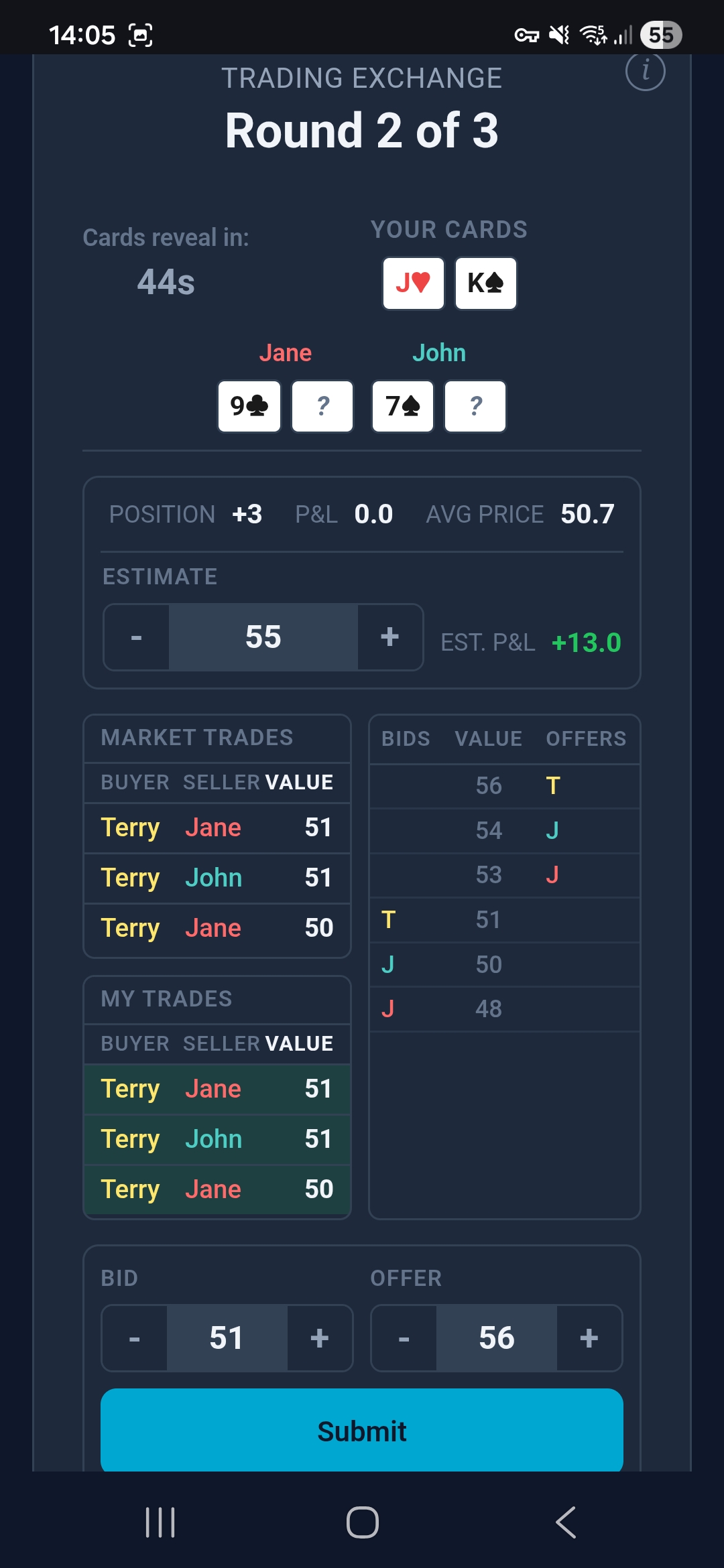
Jane and John react by adjusting their prices up.
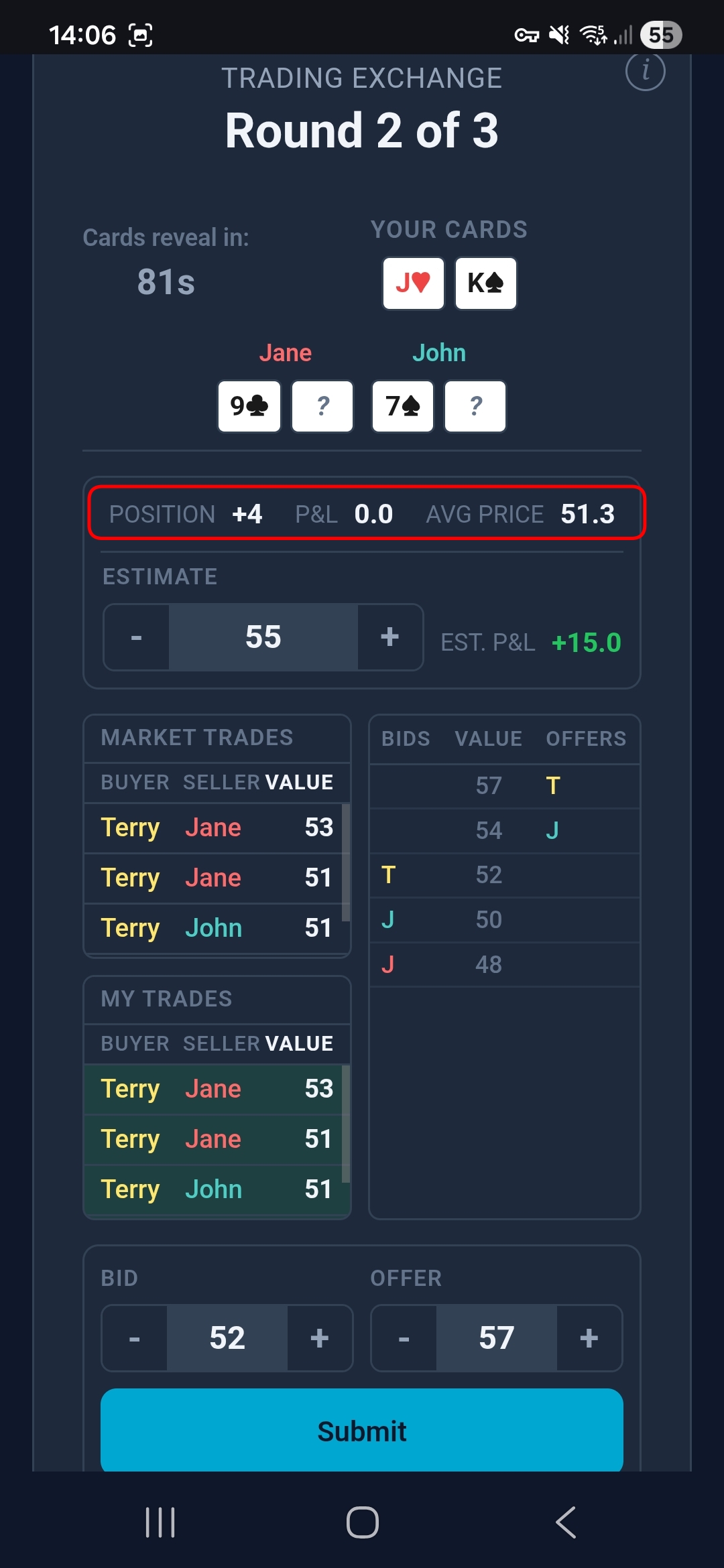
Jane's offer is still pretty low, so we decide to buy her $53 offer as well. We now have +4 nuggets which we've bought for an average $51.30
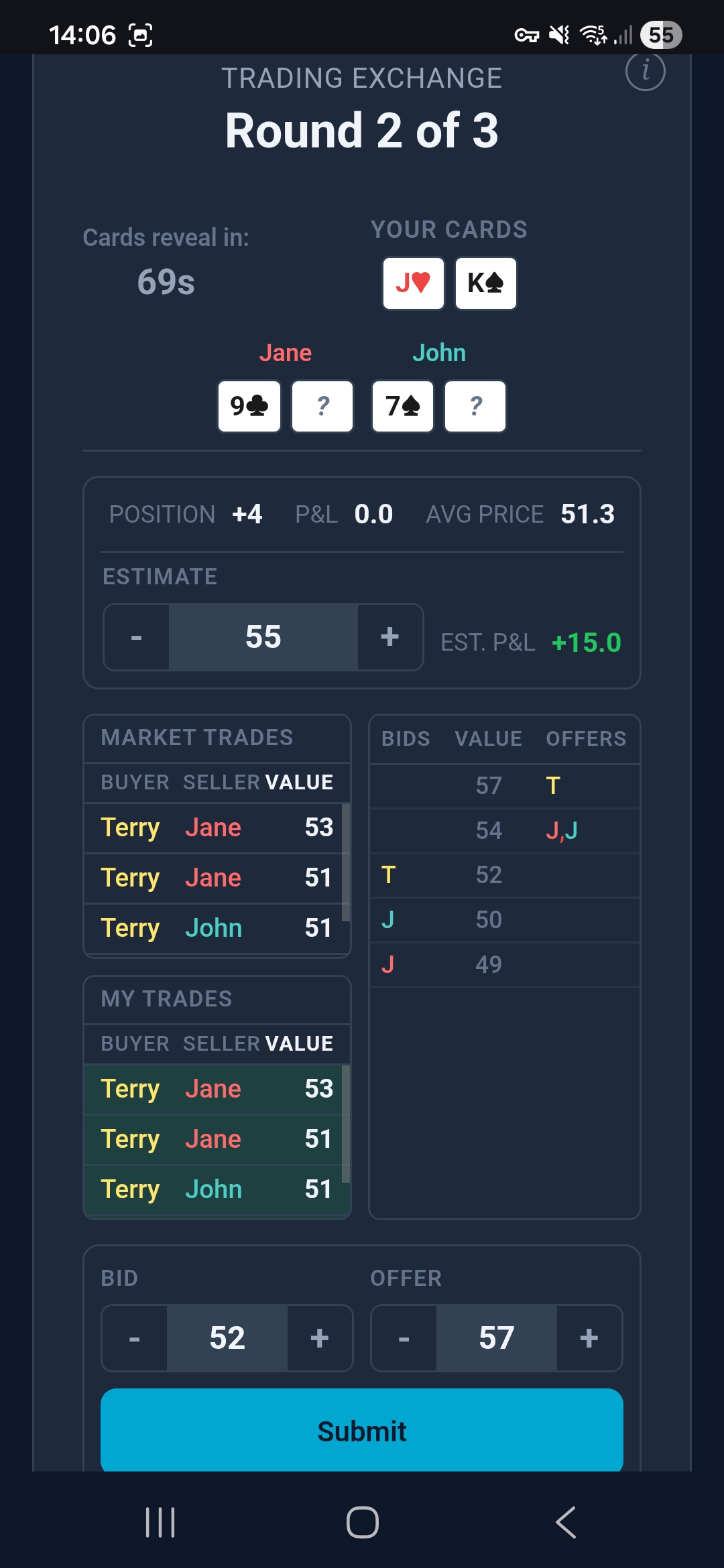
Jane adjusts again to join John's offer at $54.
Final Round
Each round reveals an additional card from each player. In the final round, all cards are shown and the true value can be calculated. Fast mental maths is required now.
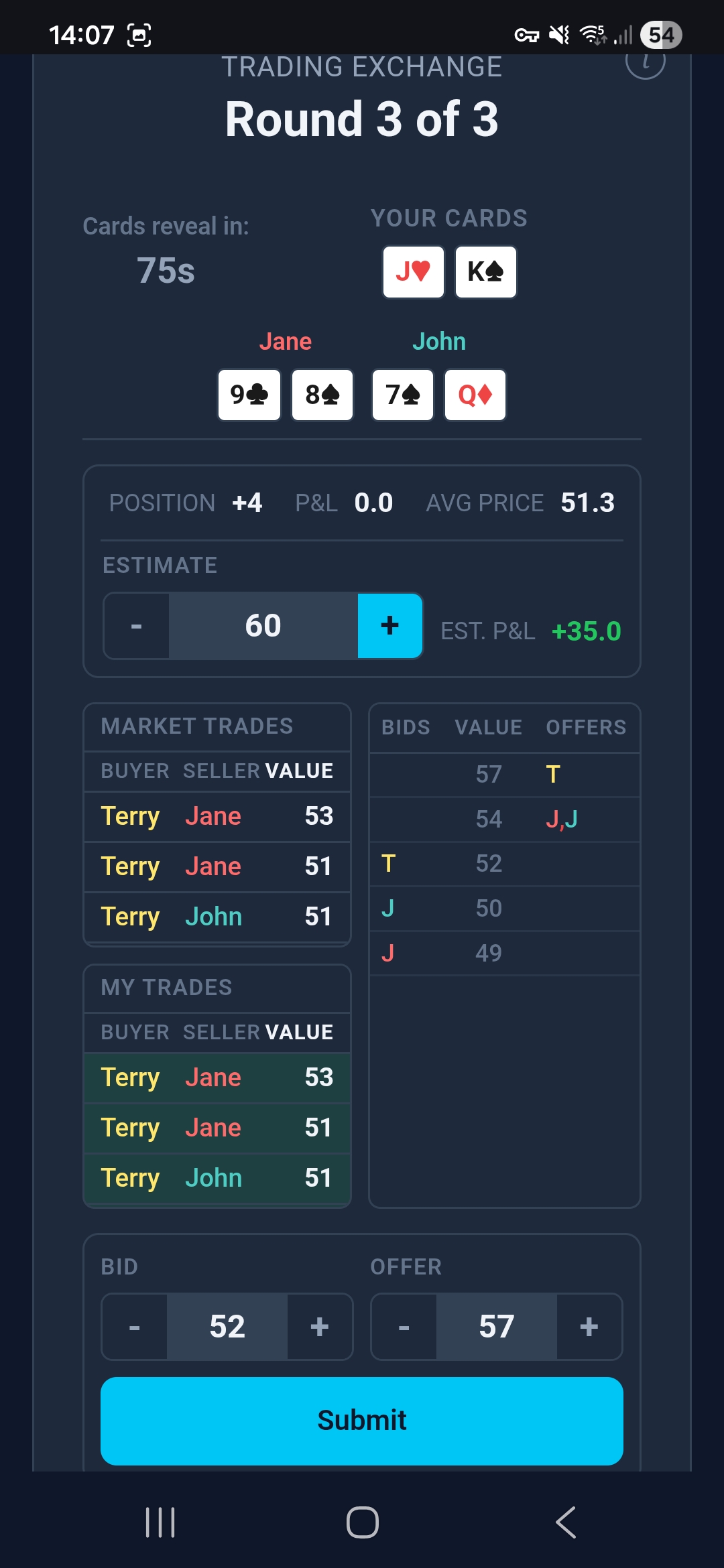
We update our final estimate to the true value, $60.
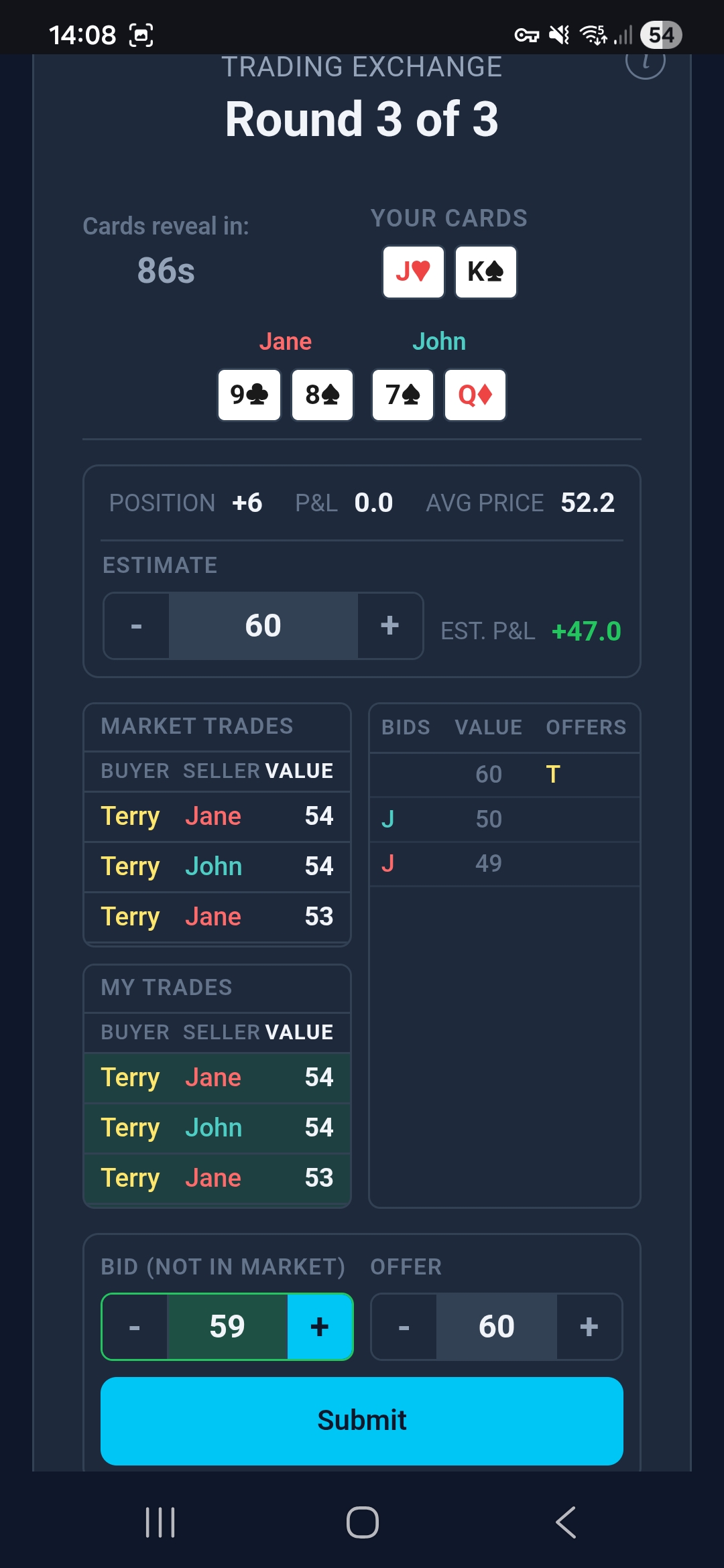
We spam the submit button to buy any offers that are still below $60.
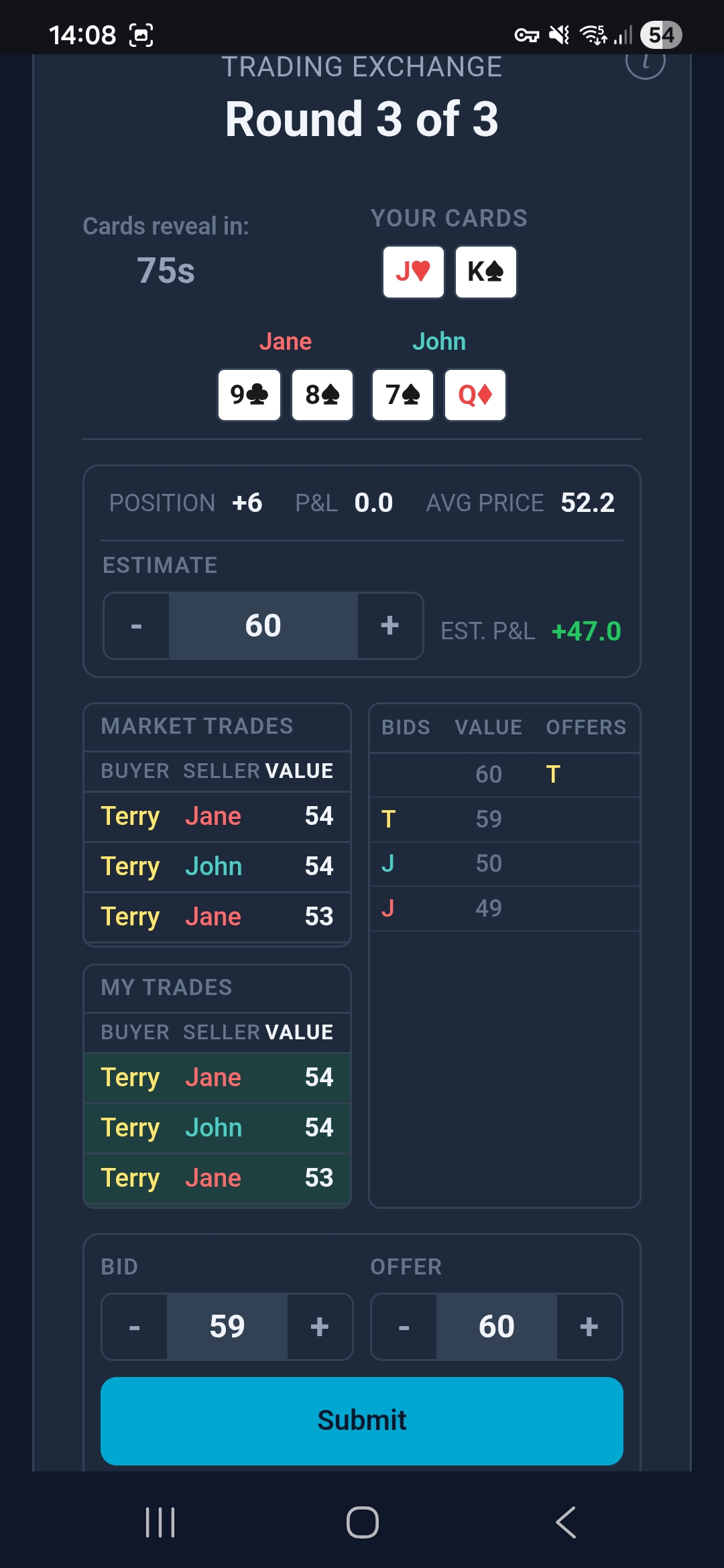
During trading, we've agreed to buy 6 gold nuggets for an average price of $52.20. We're expecting $47 profit.
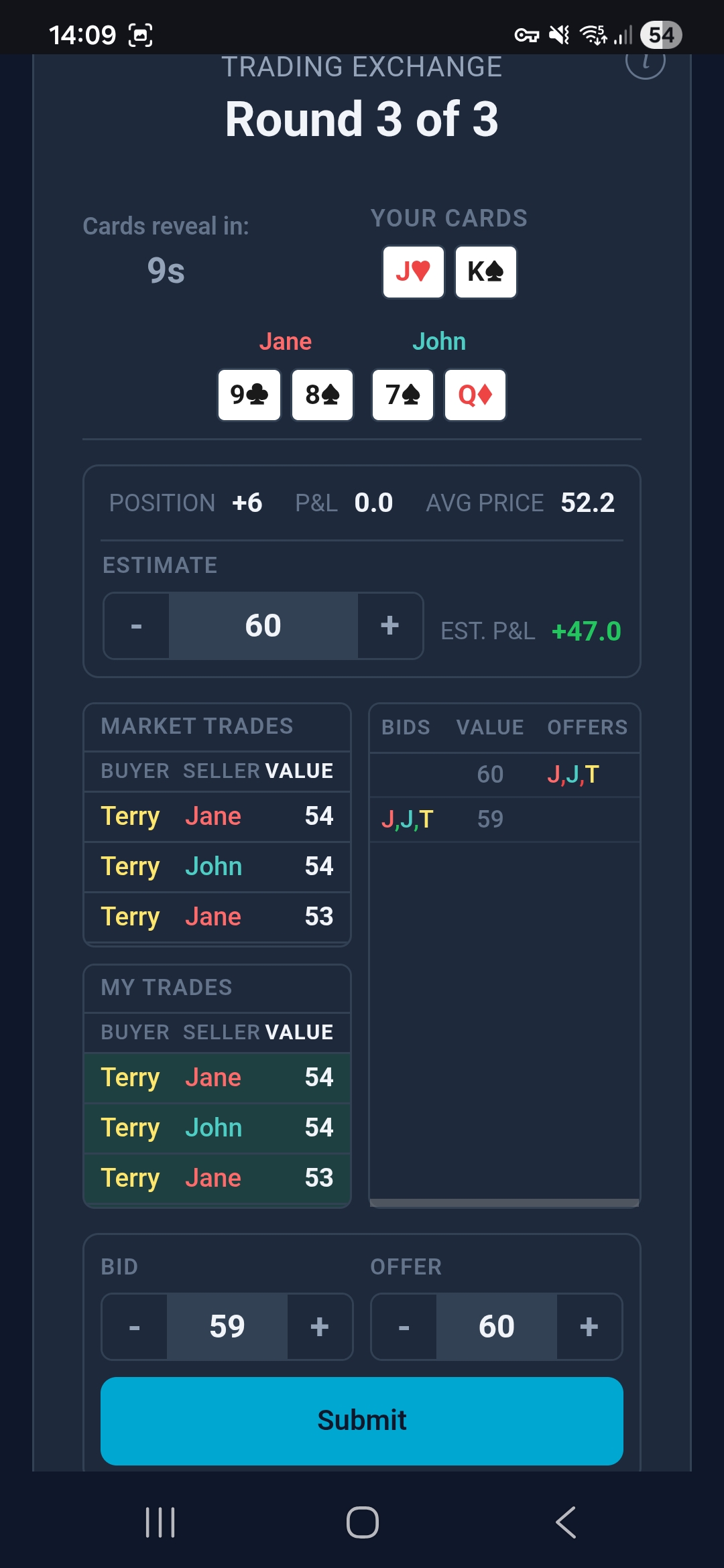
Jane and John react but it's too late.
Leaderboard
The leaderboard shows final profit tallies — most profit wins.
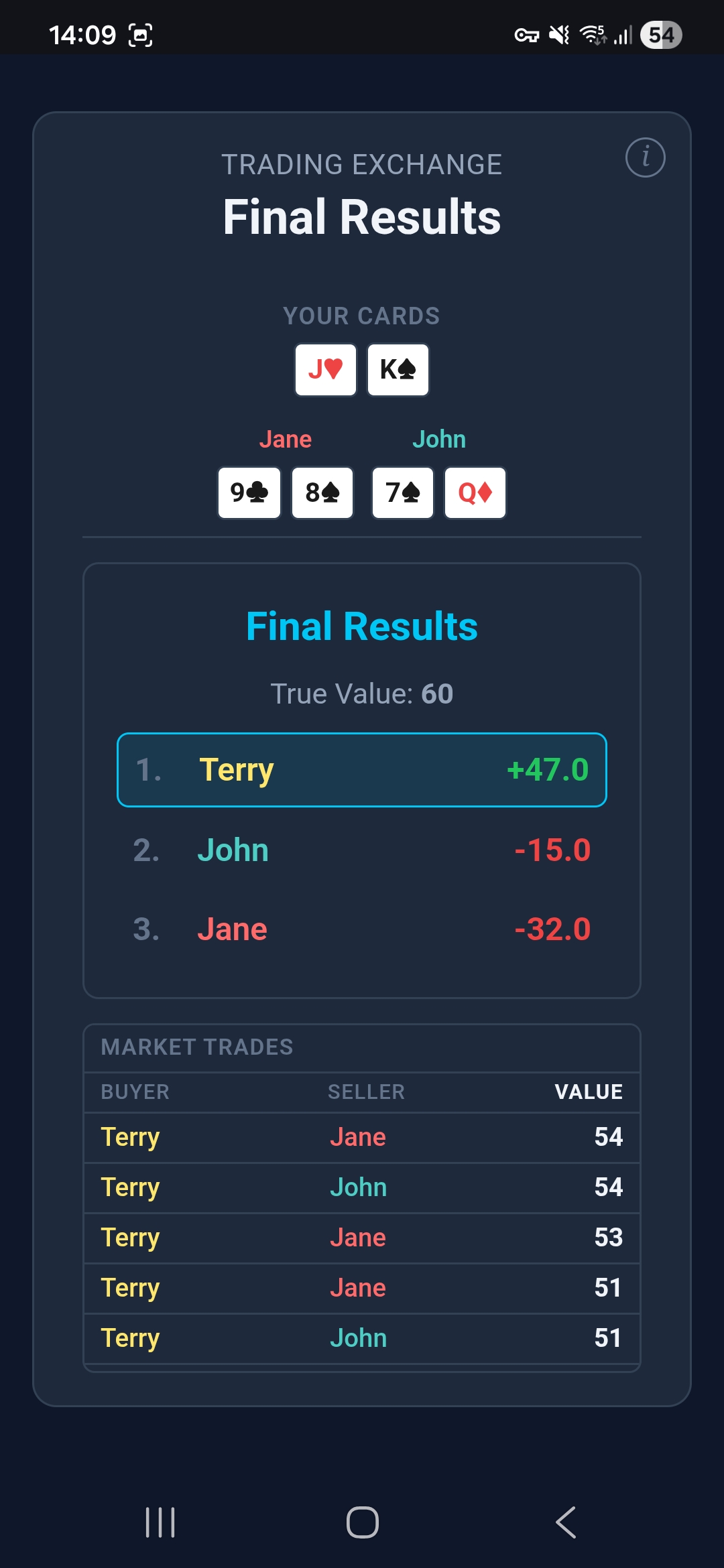
Our calculations were correct, Jane and John lost money because they sold their gold nuggets for under value.
Rules
- Deal: Everyone is dealt cards (Ace=1, 2-10, Jack=11, Queen=12, King=13). Estimate the total value of all cards and trade to profit.
- Auction: Enter a bid (max you'd pay) and offer (min you'd sell for). If your bid exceeds another's offer you automatically buy; if your offer is below another's bid you automatically sell.
- Trade: Update your bid and offer anytime. Trades happen instantly when they cross.
- Reveal: Each round reveals one card per player. If trades stall, more cards are revealed. All cards are shown in the final round.
- Profit: A BUY trade profits if the final card value is higher than your trade price. A SELL trade profits if the final value is lower.
- Winner: All trades settle at the total card value. Most profit wins! Ties are possible.
Medals
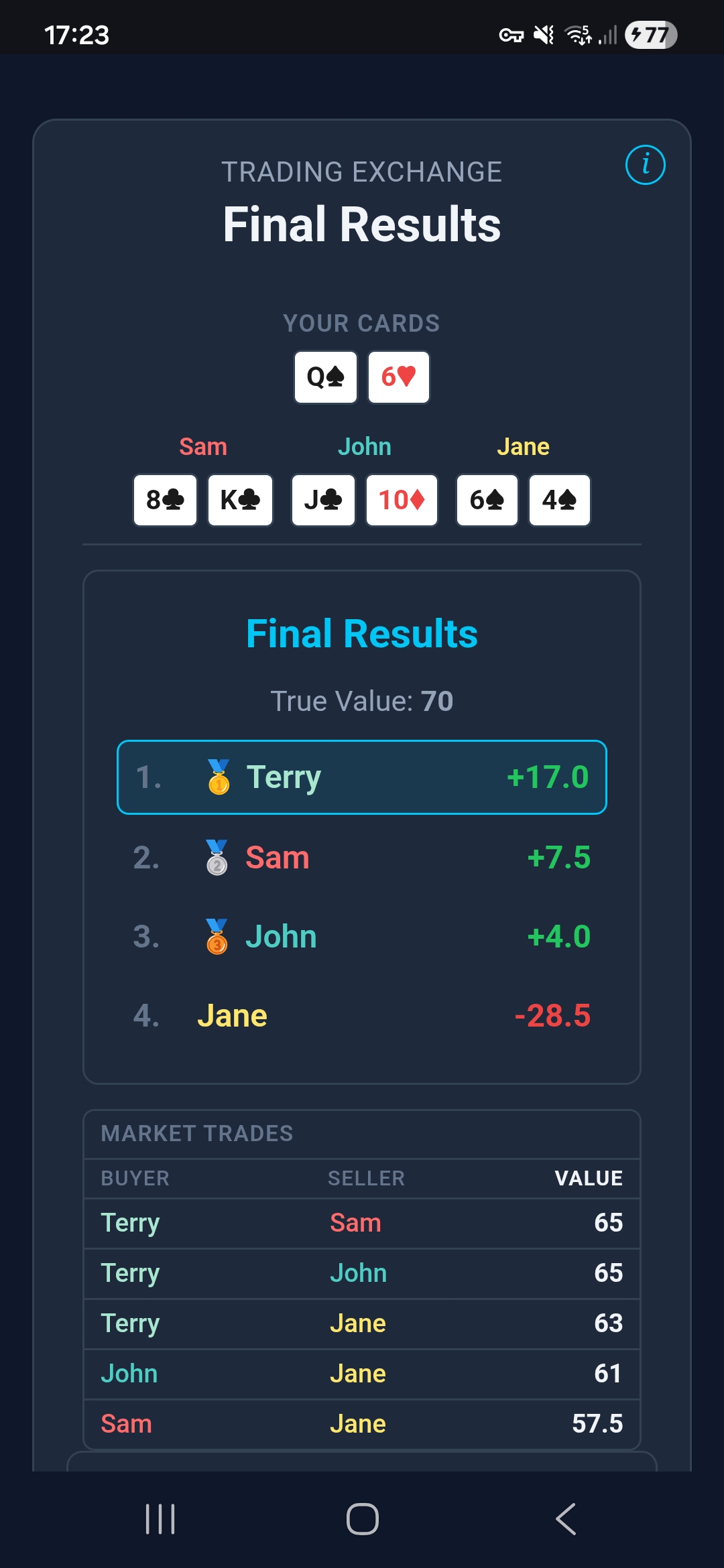
The top 3 traders receive medals!